

Luciferase
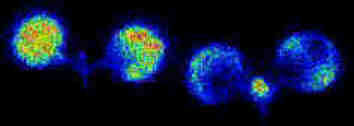
Luciferases are enzymes that emit light. A diverse group of organisms use
luciferase-mediated bioluminescence to startle predators or to attract prey or mates. The
luciferase from the North American firefly releases green light during the oxidation of
its chemical substrate, luciferin. Other organisms, including plants, that express the
luciferase (LUC) gene will also glow faintly green when supplied with luciferin.
The glow is widely used as an assay for LUC expression, which acts as a "reporter" for the activity of any genetic regulation that controls the expression of its gene. Luciferase is particularly useful as a reporter in living cells and organisms. LUC gene fusions provide a "window" on to the mechanisms that regulate the activity of specific genes, in specific, living cells. Our interest is in the mechanism of rhythmic regulation in higher plants: a rhythmically-expressed luciferase reporter has been one of our principal tools since 1990 (published in Millar et al. Plant Mol Biol Rep 1992 (Arabidopsis); Millar et al. Plant Cell 1992 (tobacco)).
Images of bioluminescence from our CAB:LUC Arabidopsis plants are shown at the top of this page (the cotyledons of two seedlings) and on the front page (an older, rosette plant).
Several different luciferase genes are now available from commercial suppliers. We most commonly use the LUC+ gene from Promega Corporation. The protein is cytoplasmic, whereas the native LUC is peroxisomal.
Luciferase Links
 | Wikipedia entry on luciferase and bioluminescence |
| American Society for Photobiology has good teaching materials and images in their Bioluminescence section. |
| Basic animation explains how reporter genes work, using luciferase as an example. |
| Firelies are beetles, (some) 'glow-worms' are their larvae. |
| There are several reviews on using luciferase in plants, for example:
|

