

Arabidopsis thaliana
"Thale cress", "mouse-ear cress" or "A Drosophila for the plant kingdom"
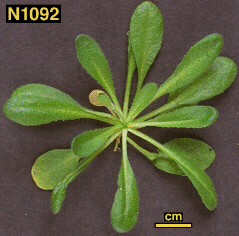 Arabidopsis
is just a little weed that you'll find in borders and
pavements in the UK and elsewhere. It is now the
leading model species for plant
biology: it has many of the features of "interesting" plants
but it is much easier to use in research, due to its
small size (leaves 1-5 cm long) and rapid growth (life
cycle of 6-8 weeks). Most importantly, many scientists around the world
are studying this plant and sharing their results. Many
mutant lines have been identified
and are now being used to address all kinds of questions. The
gene affected by a mutation can be cloned relatively easily,
which is facilitated by the small genome
(125 million base pairs of DNA, similar to the fruit fly
Drosophila, ~3% of human).
The DNA sequence of the genome was completed by a
multinational consortium in December 2000, the first of any higher plant.
The sequence is extremely useful in understanding plant
biology.
Arabidopsis
is just a little weed that you'll find in borders and
pavements in the UK and elsewhere. It is now the
leading model species for plant
biology: it has many of the features of "interesting" plants
but it is much easier to use in research, due to its
small size (leaves 1-5 cm long) and rapid growth (life
cycle of 6-8 weeks). Most importantly, many scientists around the world
are studying this plant and sharing their results. Many
mutant lines have been identified
and are now being used to address all kinds of questions. The
gene affected by a mutation can be cloned relatively easily,
which is facilitated by the small genome
(125 million base pairs of DNA, similar to the fruit fly
Drosophila, ~3% of human).
The DNA sequence of the genome was completed by a
multinational consortium in December 2000, the first of any higher plant.
The sequence is extremely useful in understanding plant
biology.
We study many mutants of Arabidopsis, especially those with altered circadian clocks, named toc1, tic, elf3 and elf4. We created transgenic plants containing fusions between regulatory regions of Arabidopsis genes and the firefly luciferase gene. The bioluminescence of these transgenic plants reflects the rhythmic patterns of gene regulation. Video imaging of the bioluminescence allowed us and others to find mutants with altered gene regulation, including clock mutants.
More information about: [Circadian Rhythms] [Video Imaging] [Luciferase]
Arabidopsis Links
 | TAIR, the database for all things Arabidopsis (including the Arabidopsis newsgroup archives, where many questions have been answered) |
| NASC, The Nottingham Arabidopsis Stock Centre (includes a mutant picture book, methods for Arabidopsis projects) |
| Lehle Seeds (commercial Arabidopsis seed supplier) |
| The
Arabidopsis thaliana Genome Research Project
|
